 Quoterra
Grow Bid Capacity Without a Larger Estimating Department
How commercial landscape owners grow bid capacity with the same estimating desk: faster packet-to-package work, human-approved AI assist, and no suite rip-and-replace.
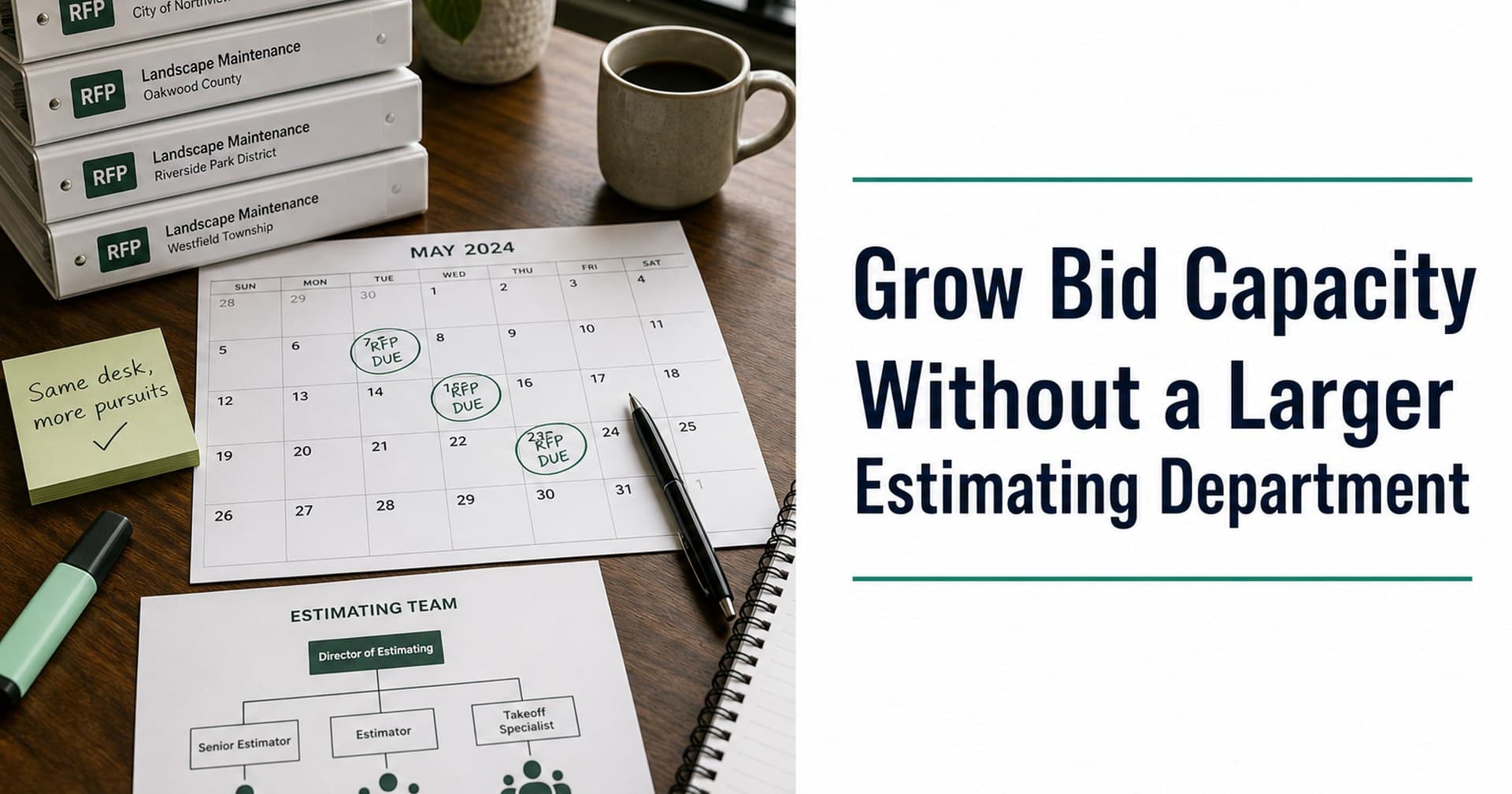
The backlog is not a mystery. Commercial and municipal RFPs keep landing. Your estimators already know how to price the work. What they do not have is another week in the calendar.
That is the growth bind for mid-market landscape owners in the US and Canada: estimating is the bottleneck. Slow turnaround means you pass on packages you would have wanted. Hiring another estimator is expensive, slow to ramp, and does not fix the retype-and-rebuild work that eats the existing desk.
Bid capacity is how many qualified commercial packages you can pursue, price, and submit in a season with the office you already have. Growing it is not the same as promising more wins. It is making sure the next live RFP does not die in PDF highlighter sets, map exports, and blank workbooks.
This guide is for owners and principals who feel that bottleneck, and for the estimating / bid managers they trust to evaluate tools. It covers where capacity actually leaks, what an AI bid loop can honestly return, and what you should not buy as “more headcount in software form.”
Capacity is pursuits, not win rate
Owners often hear two pitches at once:
- More bids out the door with the same people
- Higher win rate because the software is smarter
Only the first belongs in an honest beta conversation. Win rate depends on price, relationships, crew availability, and whether the package was even responsive. Software that “guarantees wins” is marketing you should walk away from.
What you can inspect on a live RFP is cycle time and completeness:
- How long from packet in to a number your estimator will sign
- Whether mapped quantities and RFP requirements still match when the estimate is locked
- Whether the submission package is still a Thursday-night scavenger hunt
If those improve, you grow bid capacity for landscape work: more qualified pursuits per season. Whether those pursuits win is still your commercial judgment.
Where the estimating department actually runs out of hours
Mid-market desks rarely lose the week on “not knowing how to estimate.” They lose it on handoffs:
| Leak | What it looks like | Capacity cost |
|---|---|---|
| Packet hunt | Re-reading PDFs for frequencies, exclusions, forms | Hours before a line item exists |
| Map / takeoff split | Quantities in one tool, price in another | Retype, drift, last-year polygons |
| Blank estimate rebuild | Scope already known; workbook starts empty | Half-days after the hard thinking is done |
| Package scramble | Number locked; affidavits and addenda still missing | Estimators unavailable for the next RFP |
Each leak is a people problem only if you treat it as “hire someone to do more copy-paste.” It is a loop problem if the same bid record never carries RFP context, site quantities, estimate lines, and package inventory together.
That is why “buy a bigger ops suite” and “hire another estimator” are both expensive answers to the same bottleneck. Neither automatically owns messy commercial RFPs through to a submission-ready package.
What “same desk, more pursuits” actually requires
A practical owner test, without inventing a case study:
- The estimator still owns the number. AI that fills line items from RFP + site context is useful. AI that prices the job with no gate is a liability. See Estimator + AI control plane.
- Measurement is approved, not autopilot. Boundaries and objects (grass, trees, shrubs) need a human check before they hit unit prices. See AI site mapping.
- The packet is structured once. Extraction into a checklist with citations beats three people highlighting three PDFs. See how to read a commercial landscape RFP.
- The package is tied to that same bid. Forms inventory and export after the estimate is locked, not a parallel Downloads folder.
If a demo cannot walk your next live RFP through that sequence, you are shopping a feature, not capacity.
How to think about payback (without fake ROI)
Honest framing for owners: hours saved per bid × loaded estimator cost, plus avoided rework when scope was missed in the packet. State the hours and rate you actually use. Do not accept a vendor’s “typical 10x” with no assumption.
What you should not treat as payback math:
| Claim | Why it fails an owner review |
|---|---|
| Guaranteed win rate | Price and relationships are not a software output |
| Regional pricing intelligence | Your rates and risk stay with the desk |
| Configurable markup as a magic feature | Margin policy is yours |
| Rip out Aspire / LMN / SingleOps on day one | Implementation drag kills the season you were trying to save |
If those suites already run ops or estimating, the useful posture is coexist: use a bid-loop front end for messy commercial RFPs, then hand a locked estimate into the systems you already trust. Capacity comes from fewer hours lost in the loop, not from a second ERP project. (More on coexisting with Aspire, LMN, or SingleOps.)
What good looks like for the owner and the estimator
For the owner / principal:
More qualified commercial packages pursued in a season with the same estimating staff. Faster turnaround so you pass on fewer RFPs because the desk was buried. Software cost discussed with sales in beta: a firm-level fee, not a percent of revenue, and no public price list here. Estimator-led evaluation: you fund a pilot when the desk says the loop is real.
For the estimating / bid manager:
Less rebuild after the packet and map are already understood. Suggestions you can accept, edit, or reject. A number you still defend in review. A package checklist that traces to this RFP, not last season’s folder.
Neither story is “AI replaced the department.” Both are about growing bid capacity with the office you already have: more of the work you know how to win when you can get it out the door.
How Quoterra frames capacity in the loop
Quoterra’s shipped narrative is one commercial landscape bid loop, not a hiring plan and not a suite replacement:
- Rapid Extraction: Structure requirements from the packet
- AI Site Mapping: Boundaries + landscape objects, with human approval
- Estimator + AI control plane: Suggest/fill line items from RFP + site context; estimator owns the number
- Bid Package: Help generate the final package for submission
Capacity is the owner-facing outcome of that loop running on live RFPs: more pursuits per season without standing up a larger estimating department first.
Ready to test capacity on a live RFP, not a slide?
If estimating turnaround is what limits how much commercial work you can chase, walk the loop on a real package with the desk that will use it.
Request a Demo: sales-guided beta, US & Canada. Bring your next commercial landscape RFP if you have one.
Prefer the process map first? See how it works · Explore the four pillars
Useful for your next bid cycle?
Talk with Quoterra