 Quoterra
Commercial Landscape RFPs: How to Read & Respond
A practical guide to reading and responding to commercial landscape RFPs, from first skim to submission package, written for estimators and bid managers.
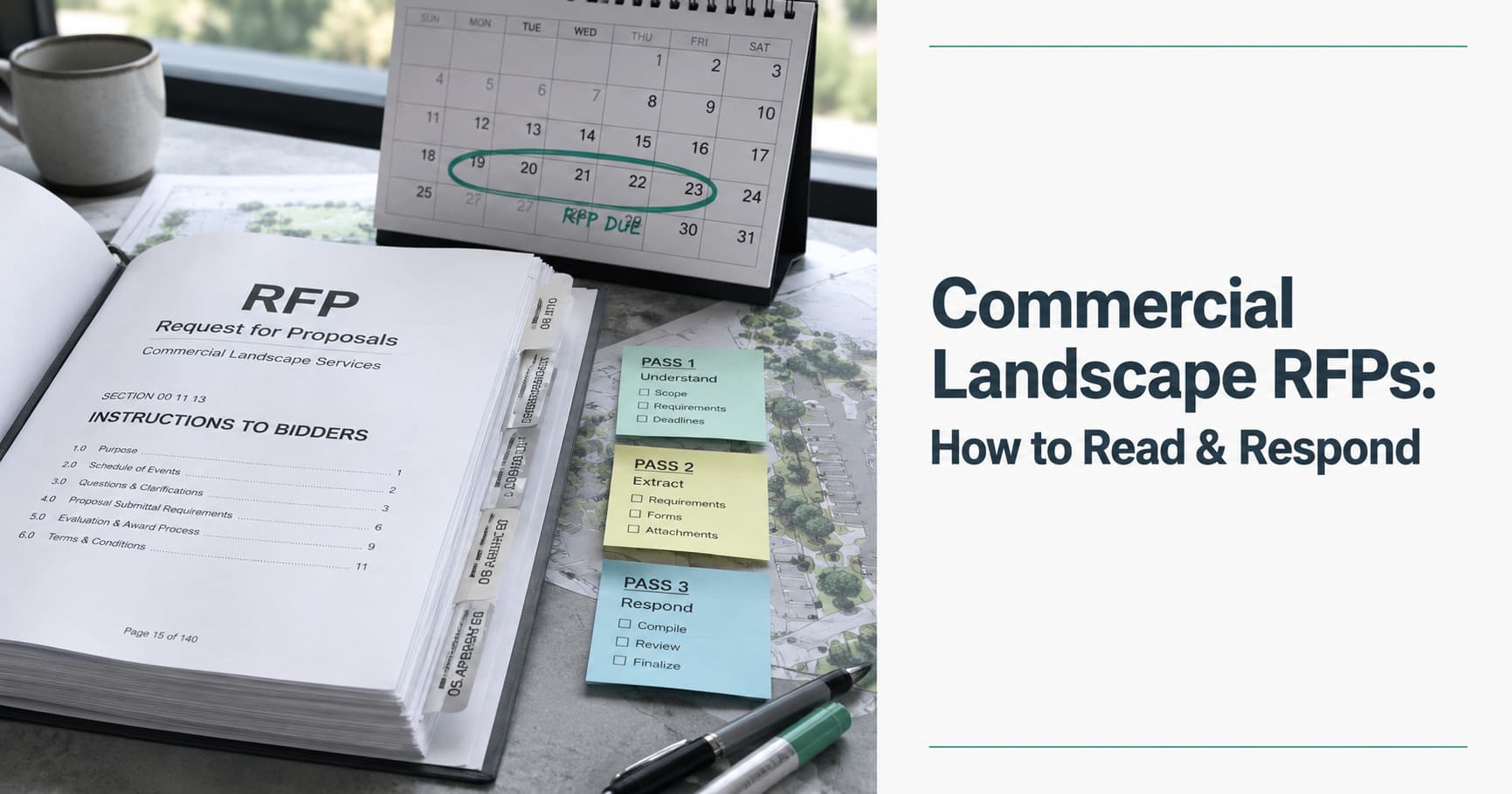
A commercial landscape RFP lands in your inbox: 140 pages, a three-week deadline, and somewhere in there, everything you need to know to win, or get disqualified. If you respond to municipal or commercial landscaping tenders, this document is your job before the job. And most estimators were never taught how to read one.
This guide walks through the full process: what's actually inside an RFP package, how to read it without drowning, how to decide whether to bid at all, and how to get from a stack of PDFs to a complete, compliant submission. It's written for estimators and bid managers at commercial landscaping companies, people who already know how to mow, plant, and price, but who lose bids on paperwork, not performance.
What a Commercial Landscape RFP Actually Is
A Request for Proposal (RFP) is a formal solicitation from an agency, municipality, property manager, or institution asking contractors to submit a priced proposal for a defined scope of landscape work, typically grounds maintenance, but also installation, irrigation, snow, or right-of-way (ROW) maintenance.
Two things make landscape RFPs different from a private "can you give me a quote" request:
- They're rule-bound. Public and institutional buyers must follow procurement rules. The RFP tells you exactly what to submit, in what format, by what deadline, and deviations usually mean disqualification, not a polite follow-up call.
- The requirements are scattered. Insurance minimums might be in Section 3, bonding in an appendix, the submission checklist in Section 7, and the actual scope of work in an attached exhibit. Nobody consolidates it for you.
The contractors who win consistently aren't necessarily the cheapest. They're the ones who found every requirement, priced the actual scope, and submitted a complete package.
Anatomy of a Typical RFP Package
Every agency formats its documents differently, but most commercial landscape RFP packages contain some version of the following. Knowing what to look for is half the battle.
The solicitation notice and instructions to bidders
The cover pages: who's buying, what they're buying, key dates (pre-bid meeting, question deadline, submission deadline), and how to submit. Read this first, always. A mandatory pre-bid meeting you didn't attend can end your bid before you've read page two.
Scope of work / specifications
The heart of the document: what work is required, where, how often, and to what standard. For maintenance contracts this usually includes service frequencies (mowing cycles, fertilization rounds, pruning schedules), performance standards ("turf shall be maintained at 2.5–3.5 inches"), and site lists. For ROW or municipal contracts, expect road segments, medians, and facility lists, sometimes as separate exhibits or spreadsheets.
Site and service area information
Maps, address lists, acreage tables, or sometimes just street names. This is what your takeoff will be built on, and it's frequently incomplete or outdated, which is why site verification matters (more on that below).
Contract terms and conditions
Payment terms, contract duration and renewal options, termination clauses, prevailing wage or living wage requirements, liquidated damages. Estimators often skip this section. Don't, a contract with net-90 payment terms and liquidated damages of hundreds of dollars per day for missed service prices very differently than a clean net-30 agreement.
Insurance and bonding requirements
Commonly required: commercial general liability, auto liability, workers' compensation, and umbrella coverage at specified minimums, plus bid bonds and performance/payment bonds on many public contracts. These vary significantly by agency and state, so treat every RFP's numbers as unique. This is one of the two categories most likely to disqualify a bid (submission forms being the other).
Submission requirements and forms
The checklist of what your response must physically contain: signed forms, acknowledgment of addenda, references, non-collusion affidavits, W-9s, licensing proof, pricing sheets in a mandated format. Many RFPs require forms to be submitted exactly as issued, retyped or reformatted versions can be rejected.
Evaluation criteria
How the buyer will score responses. Lowest-price contracts and best-value contracts demand different strategies: on a best-value RFP weighted 40% on qualifications and approach, a thin technical response loses to a well-written one even at a higher price.
How to Read an RFP Without Drowning
A 150-page RFP isn't meant to be read like a book. Experienced estimators read it in passes.

Pass 1: The 30-minute qualification skim
Before committing hours, answer four questions:
- Can we do this work? Scope, geography, service capacity.
- Are we eligible? Licensing, certifications, minimum experience requirements, mandatory pre-bid attendance.
- Can we meet the insurance and bonding requirements? If the RFP requires a performance bond beyond your current bonding capacity, that's a conversation with your surety before it's an estimating exercise.
- Is the timeline workable? Count backward from the deadline. If site visits, subcontractor quotes, and bond paperwork can't fit in the window, walking away early is cheaper than a rushed, sloppy submission.
If any answer is a hard no, stop. The most expensive bids are the ones you were never going to win.
Pass 2: The requirement extraction read
This is the slow, careful read where you pull every obligation out of the document and into a structured list, a compliance checklist or matrix. Go section by section and capture:
- Every "shall," "must," and "required" statement
- Every document you must submit (with the exact form name and version)
- Every deadline and milestone (question cutoff, addenda acknowledgment, submission date and time)
- Every insurance type, limit, and endorsement
- Bonding requirements and when each bond is due
- Personnel requirements (certified applicators, supervisor qualifications, staffing minimums)
- Performance standards you'll be held to after award
Capture the source location (section and page) for each item. When a teammate asks "where does it say we need an arborist on staff?", you want an answer, not another full read.
This is also where most manual processes break down. Requirements hide in non-obvious places, an insurance endorsement mentioned only in the sample contract, a form referenced in an addendum. Some teams do a two-reader review; others use AI extraction tools that scan the document against a standard set of requirement categories and produce a structured checklist to verify. Either way, the goal is the same: no requirement lives only in the PDF.
Pass 3: The pricing read
Read the scope of work again, this time as an estimator: what are the quantities, frequencies, and standards that drive cost? Flag ambiguities, a site list without acreages, a mowing spec without a defined season length, and submit them as formal questions before the question deadline. The written answers (issued as addenda) become part of the contract; verbal assurances don't.
The Go/No-Go Decision
After Pass 1 and a partial Pass 2, make a deliberate bid decision. A simple framework:
- Compliance fit: Can we meet every mandatory requirement, eligibility, insurance, bonding, personnel, by the deadline? One unfixable gap is a no-go.
- Competitive fit: Do we have an advantage here, route density near the sites, incumbent knowledge, relevant references, or are we column fodder for a buyer who already has a favorite?
- Financial fit: Do the contract terms (payment timing, liquidated damages, renewal structure) work at a margin we'd accept?
- Capacity fit: If we win, can we actually staff and equip it without breaking existing contracts?
Write the decision down, whichever way it goes. Over a year, your go/no-go log becomes your best data on which bids are worth your estimating hours.
Building Your Response
Work backward from the deadline
Build a response timeline the day you decide to bid. Typical milestones, in reverse order: submission (aim for a day early), final package review, pricing sign-off, bond and insurance certificate requests (sureties and brokers need lead time, often a week or more), subcontractor quotes due, site visits complete, questions submitted before the cutoff. Missing an internal milestone is recoverable; missing the submission deadline is not, and procurement offices generally cannot accept late bids no matter how good the excuse.
Verify the sites and do the takeoff
The RFP's site list is your starting point, not your answer. Confirm locations, measure the actual maintained areas, turf, planting beds, tree counts, hardscape, road segment lengths for ROW work, and reconcile against any quantities stated in the RFP. If the RFP says a park is 12 acres of turf and your measurement says 9, that discrepancy is either a question for the agency or a margin opportunity, but only if you catch it. Contractors do this with field visits, GIS tools, or satellite-based measurement; the method matters less than having defensible quantities behind every line item.
Price from the requirements, not from habit
Every priced line should trace back to a scope requirement and a measured quantity: this many mowing cycles across this much turf at this production rate. Then load the costs the RFP's terms create, certified personnel, reporting requirements, prevailing wage where applicable, bond premiums, the working capital cost of slow payment terms. A bid priced off last year's similar contract without re-reading this year's terms is how margins quietly disappear.
Assemble the submission package against the checklist
Return to your Pass 2 requirement list and check off every form, certificate, and document, in the format and order the RFP specifies. Common failure points worth double-checking on every bid:
- Unsigned forms, or forms signed by someone without authority to bind the company
- Missing acknowledgment of addenda (every addendum, individually, if required)
- Insurance certificates that don't match the required limits or omit a required endorsement
- Pricing submitted in your own spreadsheet format when the RFP mandated its form
- Bid bond missing or in the wrong amount
Have someone who didn't build the package review it against the checklist. Fresh eyes catch what tired eyes skip.
Common Mistakes That Kill Landscape Bids
- Skimming instead of extracting. Reading the RFP without producing a requirements checklist means every requirement is a memory test.
- Ignoring addenda. Agencies issue changes right up to the deadline. Unacknowledged addenda are a standard disqualification trigger.
- Treating boilerplate as boilerplate. The "standard" contract terms are where liquidated damages, wage requirements, and payment terms live.
- Pricing before measuring. RFP-stated quantities are often stale. Bid on what's actually on the ground.
- Starting compliance paperwork last. Bonds and insurance endorsements have external lead times you don't control.
- Submitting at the deadline. Portals crash, files exceed size limits, offices close early. A day of buffer costs nothing.
Where This Process Is Heading
The mechanics described above, extraction read, compliance checklist, requirement tracing, package assembly, have traditionally been done by hand, in spreadsheets and highlighted PDFs. That still works, but it's slow and it's fragile: one distracted afternoon and a requirement gets missed.
AI document tools can automate parts of the extraction read, scanning an RFP into structured categories (insurance, bonding, timeline, forms, scope) for a human to verify. The judgment calls (go/no-go, pricing, risk) stay with the estimator. If you're evaluating that workflow for a commercial landscape desk, Request a Demo and walk Rapid Extraction on a real RFP with Quoterra, or see how the full loop works.
The Bottom Line
Responding to a commercial landscape RFP is a process, not a heroic reading session: qualify fast, extract every requirement into a checklist you can trace, decide deliberately whether to bid, measure what you'll actually maintain, price from the requirements, and assemble the package against the checklist, early. Contractors who systematize this win more not because they bid lower, but because their bids survive the compliance cut and price the real scope.
Ready to run this on a live RFP?
Quoterra helps commercial landscape estimating desks move from messy RFP packets through Rapid Extraction, AI Site Mapping, Estimator + AI control plane, and Bid Package help for submission, with your team approving the gates.
Request a Demo. Sales-guided beta, US & Canada. Bring your next package if you have one.
Prefer the process map first? See how it works · Explore features
We also publish guides like this. Subscribe if you want them as they're released.
Useful for your next bid cycle?
Talk with Quoterra