 Quoterra
Coexist with Aspire, LMN, or SingleOps: Keep Your Stack, Own the Bid Loop
Keep Aspire, LMN, or SingleOps as your desk of record. Use an AI bid loop for messy commercial RFPs, then hand off. No day-one stack replacement.
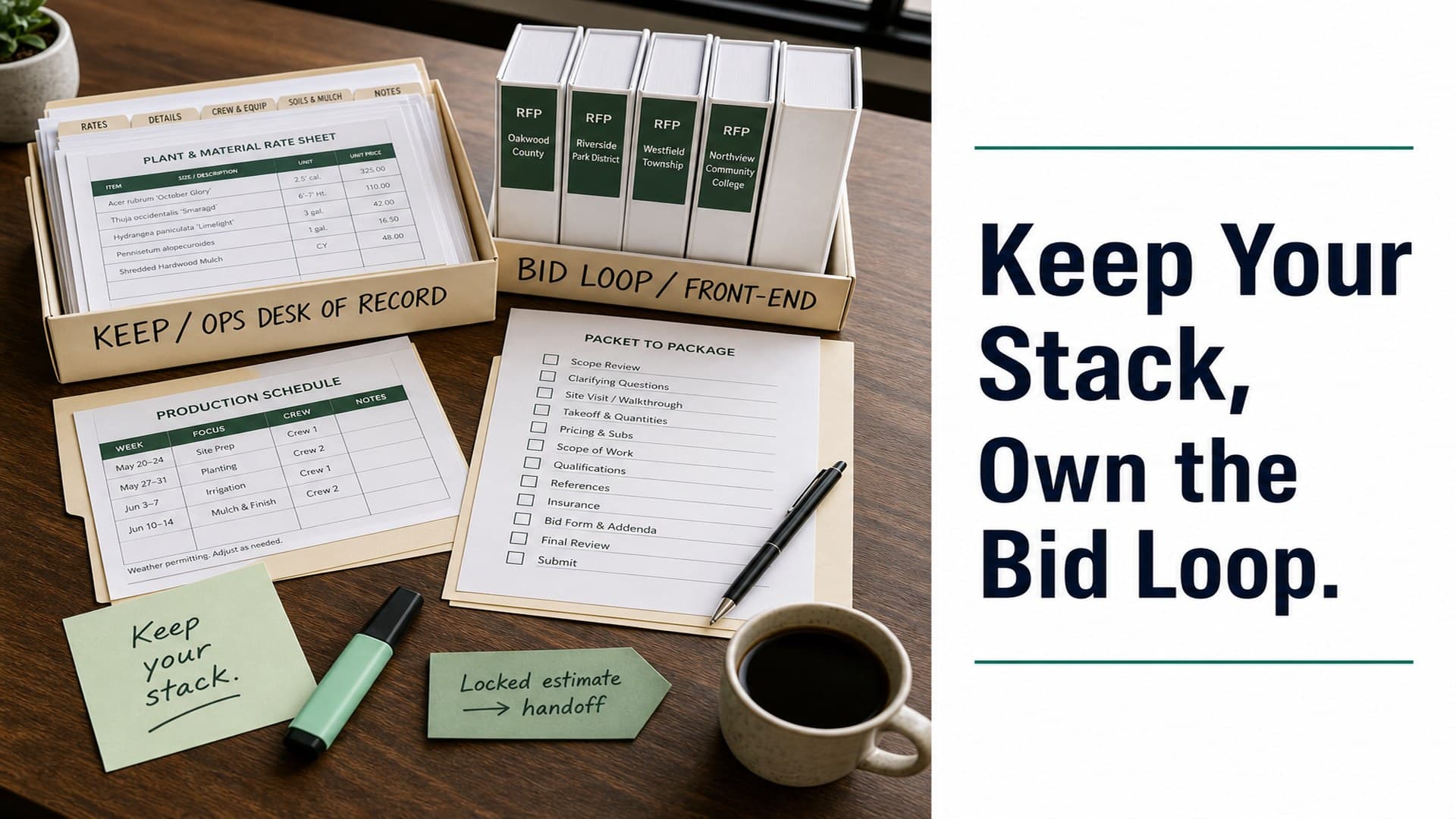
If your commercial landscape firm already runs on Aspire, LMN, or SingleOps, the next vendor pitch often sounds the same: rip it out, migrate everything, and start clean.
That is rarely what mid-market owners in the US and Canada can afford mid-season. Crews, catalogs, proposals, and billing already live in the suite. Estimators already know the desk. A day-one stack replacement is an implementation project dressed up as “AI.”
Coexist with Aspire LMN landscape stacks (and SingleOps) is the honest posture: keep the ops / estimating suite as your system of record, and put a dedicated AI bid loop in front of the messy commercial RFP, so packet work, site quantities, estimate fill, and package prep stop getting retyped between tools.
This guide is for owners who refuse a second ERP project, and for estimating / bid managers who still have to get the next municipal package out the door.
Why “replace the stack” fails the owner test
Rip-and-replace sounds efficient on a slide. In practice it fails three checks:
| Owner check | What goes wrong |
|---|---|
| Season timing | Migration eats the months you needed for pursuits |
| Desk trust | Estimators lose the catalog and workflows they already defend |
| Category mix-up | You bought a bid front-end problem and got sold a full FSM / CRM rebuild |
Aspire, LMN, and SingleOps are strong when they are already the desk of record for ops, production rates, proposals, or crew workflows. Quoterra’s job is not to pretend it is that suite on day one. Its job is the commercial landscape bid loop: RFP → map → estimate → package for submission.
If a vendor leads with “we replace Aspire / LMN / SingleOps,” treat that as a red flag unless you asked for a full suite migration. Most firms asked for faster, cleaner bids, not a second go-live.
What the suite owns vs what the bid loop owns
Category contrast, not a dunk on any one product:
| Layer | Typical home today | What “good” looks like |
|---|---|---|
| Ops / CRM / crew / catalog desk | Aspire, LMN, SingleOps (when already SoR) | Keep it. Do not rip for a bid-tool pilot. |
| Measure / takeoff SoR | SiteRecon, Beam, or suite measure (when already SoR) | Keep it when it is already trusted; see AI site mapping for how Quoterra frames Map beside that. |
| Messy commercial / municipal RFP packet | PDFs, email, highlighter sets | Structure once: Rapid Extraction |
| Estimate continuity | Blank workbook after map export | Control plane fill from RFP + site context; estimator owns the number |
| Submission package | Last-minute Downloads folder | Help generate the package for submission, not full e-sign / CRM parity |
The mistake is forcing one product to win every row. Suites win ops gravity. Takeoff tools win measurement depth. The bid loop wins continuity from the packet you received to the package you submit.
Coexist in practice: front-end the RFP, hand off the locked number
A practical handoff model for firms already on Aspire, LMN, or SingleOps:
- Ingest the live RFP in the bid workspace (scope, frequencies, exclusions, forms inventory).
- Approve the site (boundaries + landscape objects) so quantities are not a silent export.
- Build the estimate with AI suggestions the estimator can accept, edit, or reject.
- Assemble the submission package tied to this bid (forms, markups, supporting docs).
- Hand off the locked estimate / package context into the suite you already run for ops, proposal polish, or job setup. Production still needs constructible quantities they can build against.
That is coexistence: Quoterra as the AI bid front-end, suite as the desk of record. Not “Quoterra replaces PropertyIntel / LMN / SingleOps.”
Owners who care about bid capacity should prefer this sequence. Capacity comes from fewer hours lost in handoffs, not from standing up a parallel ERP.
Claims you should reject (from anyone)
Whether you evaluate Quoterra or a peer, walk away from these as product promises:
| Claim | Why it fails |
|---|---|
| Day-one full stack replacement | Implementation drag; wrong category |
| Full e-sign / CRM / crew-ops parity with Aspire, LMN, or SingleOps | Suites own that depth; bid tools should not fake it |
| Guaranteed win rate | Price, relationships, and crew availability are not a software output |
| Smart Bids / regional pricing intelligence / configurable markup as magic features | Your rates and margin policy stay with the desk |
| “Another SiteRecon/Beam” as the whole story | Map is contested; own the RFP → package loop, not takeoff parity alone |
Honest language sounds narrower and more useful: works alongside the suite, helps generate the final bid package for submission, estimator owns the number.
Questions to ask before you buy (or before you rip)
Use these in a demo, vendor bake-off, or internal steering meeting:
- Does this tool ask us to migrate Aspire / LMN / SingleOps before we see value on one live RFP?
- Where does the locked estimate go after the package is ready: export, handoff, or “stay forever in our new CRM”?
- Is Bid Package assistive (fill, annotate, assemble, verify, export) or are they pitching e-sign / ops parity?
- Can our estimating / bid manager run our next commercial RFP end to end with human approval gates?
- Are we buying continuity (packet → map → estimate → package) or only one contested layer (map-only or proposal-only)?
If the answers force a rip-and-replace before a pilot proves the loop, you are shopping an implementation program, not a bid front-end.
How Quoterra frames coexistence
Quoterra’s shipped narrative for commercial landscapers in the US and Canada:
- Rapid Extraction: Structure requirements from the packet
- AI Site Mapping: Boundaries + landscape objects, with human approval
- Estimator + AI control plane: Suggest/fill line items from RFP + site context
- Bid Package: Help generate the final package for submission
Positioning: sit between landscape AI takeoff tools and ops/estimating suites. Lead with the messy RFP through to a submission-ready package. Coexist by default with Aspire, LMN, SingleOps, and an existing takeoff SoR when that SoR is already trusted.
See the four pillars and how it works for the product map behind this post.
Ready to keep your suite and test the bid loop?
If Aspire, LMN, or SingleOps already runs the firm, you do not need a stack replacement to bid cleaner commercial packages. You need a front-end that respects the desk you already trust.
Request a Demo: sales-guided beta, US & Canada. Bring your next live RFP and the suite you plan to keep.
Prefer the process map first? See how it works · Explore the four pillars
Useful for your next bid cycle?
Talk with Quoterra