 Quoterra
Predictable Software Spend for Landscape Firms, Not a Percent of Revenue
How commercial landscape CFOs keep software spend predictable: firm-level fees tied to bid volume, not a percent of revenue. What to ask on a demo.
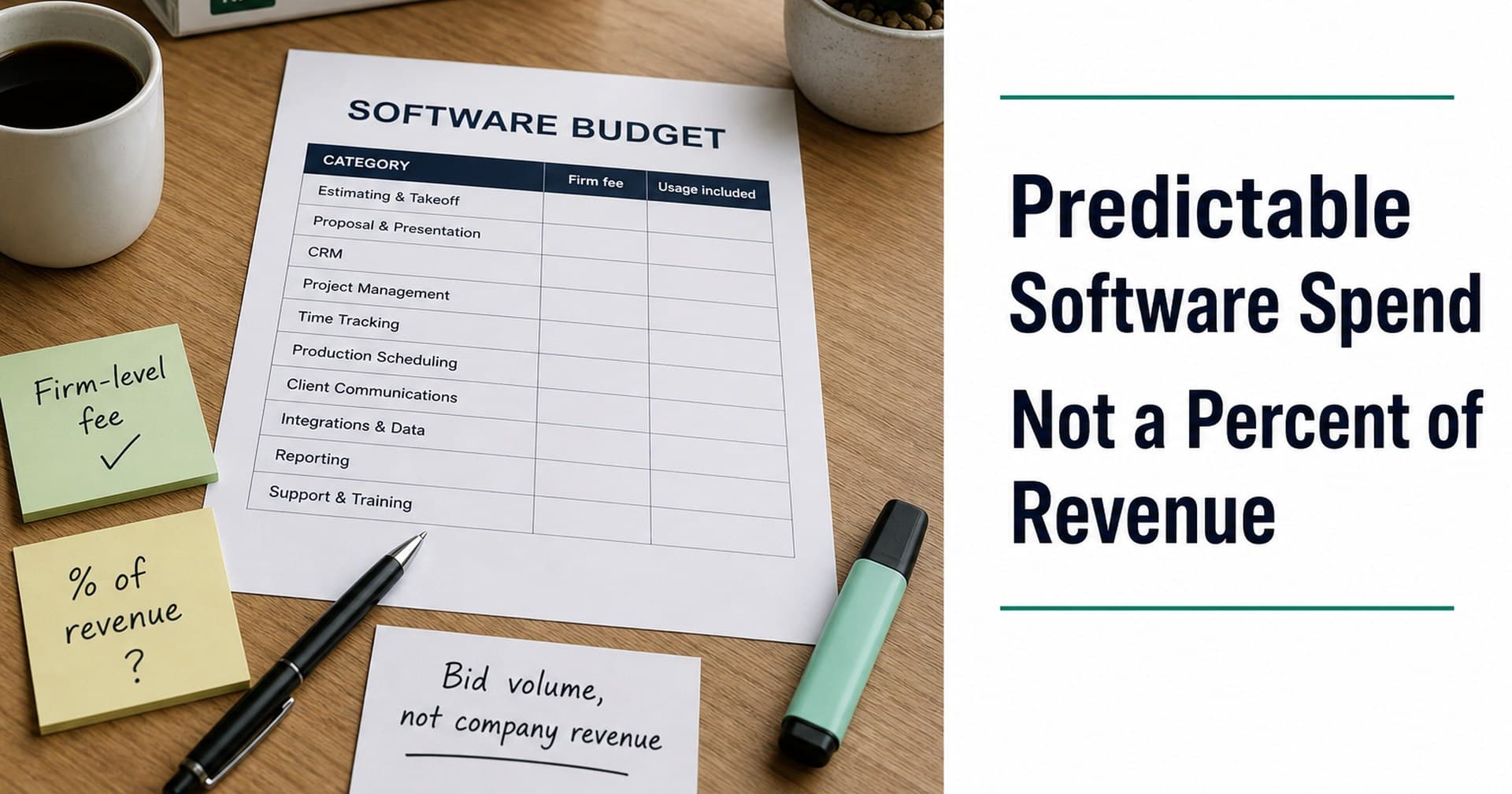
A good commercial year should not automatically raise the software bill.
That is the finance problem at a lot of mid-market landscape firms in the US and Canada. Revenue is up. The estimating desk did not add seats. Bid volume on a given tool may not have moved. The renewal still comes in higher because last year’s top line did.
Predictable software spend for a landscape firm is a number you can put in the budget before the season starts: a firm-level fee, clear included usage, and written rules for what happens if you exceed it. It is not a silent tax on winning more work.
This guide is for CFOs and controllers who have to forecast that line, and for owners who do not want growth to feel punitive in the stack. It is not a public price list. Quoterra is in sales-gated beta. The point is the model, and the questions you should refuse to leave a demo without.
Two ways landscape software gets billed
Landscape ops and estimating tools tend to land in one of two buckets.
Revenue-linked. The fee moves with company revenue, or with a custom enterprise formula that behaves like it. A stronger book of commercial work raises the software line even when you added no users and ran no extra takeoffs through that product.
Firm-level. A subscription or hybrid plan you can name in the budget: seats, modules, or included bid / AI / GIS volume, with an upgrade or overage path when usage exceeds the plan.
Neither model makes a product good or bad. Plenty of firms run excellent ops suites on custom enterprise contracts. Finance still has to live with the forecast. If the bill scales with revenue, you are modeling a share of last year’s work, not the cost of estimating the next RFP.
Owners feel this as “software that charges as we grow.” Controllers feel it as a line they cannot lock. Both are the same objection: predictable software spend landscape buyers can defend in a budget meeting.
Why a percent of revenue is hard to budget
A percent-of-revenue fee is simple on a slide. It is messy in a forecast.
You do not control the input the same way you control seats. Revenue moves with mix, weather, retained contracts, and one large municipal win. The software did not do that work. The crews and the estimators did. Tying the tool bill to company revenue treats growth as a software event.
It also collides with tool sprawl. Mid-market desks already pay for an ops suite, a map or takeoff tool, accounting, and whatever AI add-on showed up this year. If one of those lines is a moving share of revenue, the rest of the stack is harder to compare. You cannot put “this estimating front end vs that one” on the same spreadsheet when one quote is a fee and the other is a tax on the whole firm.
AI makes the forecast worse when overages are fuzzy. Token pools, “unlimited until it isn’t,” and unstated GIS volume are the same problem in a different costume. Unpredictable AI overages are a CFO pain even when the base plan looks cheap.
None of that is an argument to rip out a suite you already trust. Keep Aspire, LMN, or SingleOps as the desk of record if that is where ops, catalogs, and crews already live. Packaging on a new bid tool is a separate decision from whether the suite is doing its job.
Predictable does not mean a public price list
Beta software will not show you a checkout page. That is fine. Predictable and public are different tests.
Predictable means you can answer these in writing after a sales call:
| Ask | What a usable answer looks like |
|---|---|
| What are we paying for? | Firm-level plan, not a share of company revenue |
| What is included? | Named volume: bids or estimates, AI, GIS / site mapping, seats |
| What happens when we exceed it? | Overage rate or upgrade path, stated before you sign |
| Who can see usage? | A monthly report finance and the estimating lead can both read |
| What is not in the product? | No invented features. If markup policy and regional price files stay in your desk, say so. |
Public means a marketing site with dollar bands. Quoterra does not publish those in beta. Neither should you treat a competitor’s unverified directory listing as a quote.
If a vendor cannot describe included volume and overage rules without hiding behind “it depends on revenue,” you do not have a software cost. You have a residual.
Tie cost to bid volume, not company revenue
The honest unit for an estimating tool is output: how many commercial packages the desk can run through extract → map → estimate → package, not how much the whole company invoiced.
That is the difference between a bid-capacity cost and a revenue tax.
Growing bid capacity is an owner problem: more qualified pursuits with the same estimating desk. Packaging should follow that story. If the tool is supposed to return hours on packet work, site quantities, line-item fill, and the submission package, then the fee should scale when that volume grows, not when a maintenance contract in another division had a good year.
A practical payback frame, with assumptions you state yourself: hours saved per bid × loaded estimator cost, plus avoided rework when scope was missed in the packet. Do not accept a vendor “typical ROI” with no hours and no rate. Do not treat win rate as a software output.
What this is not:
- A promise that Hybrid tiers are live on a public page. They are the intended GA path: Starter / Pro / Enterprise with included AI, GIS, and bid volume, then overage or upgrade when you exceed the plan.
- A claim that Quoterra is cheaper than an ops suite. Different job. Different line item.
- Permission to skip the estimator. The control plane fills from RFP and site context. The desk still owns the number.
What finance and the owner should hear in the same meeting
For the CFO / controller: A recurring SaaS line with boundaries. Usage you can see. Cost that moves with bids and estimates processed, not with company revenue percentage. Security and contract hygiene still matter. Packaging is what makes the rest of the review possible.
For the owner / principal: You can grow commercial pursuit volume without the software bill tracking last year’s top line. You still evaluate on a live RFP with the estimating lead. You still do not rip the suite to get a bid front end.
If those two stories diverge on the call, someone is selling a feature list, not a cost model.
How Quoterra frames packaging
Quoterra is the AI engine for commercial landscape bidding: Rapid Extraction, AI Site Mapping with boundaries and landscape objects, Estimator plus an AI control plane, and help generating the final bid package for submission.
How that gets paid for:
- Beta now. Sales-gated. Custom design-partner agreements. No public price list. Outreach → qualification → paid or sponsored beta.
- GA intent. Hybrid tiers with included AI, GIS, and bid volume. Overage or upgrade when volume exceeds the plan. Firm-level fees landscapers can budget.
- What we will not do. Price as a percent of contractor revenue. Publish dollars before Founder and Finance clear them. Pretend AI overages are “unlimited.”
The product conversation on a demo is still the loop on your next live RFP. Bring finance’s packaging questions to the same call. Do not save them for a later procurement surprise.
Ready to talk packaging without a percent-of-revenue quote?
If the next software decision has to survive a budget review, walk the bid loop with the estimating desk and ask for included volume in writing.
Request a Demo: sales-guided beta, US & Canada. Bring your next commercial landscape RFP, and the questions in the table above.
Prefer the process map first? See how it works · Explore the four pillars
Useful for your next bid cycle?
Talk with Quoterra