 Quoterra
Why Landscaping Contractors Miss Critical RFP Requirements (And What It Costs Them)
Missed RFP requirements quietly kill landscaping bids. Here's why manual review fails, what a disqualified bid really costs, and how to stop it.
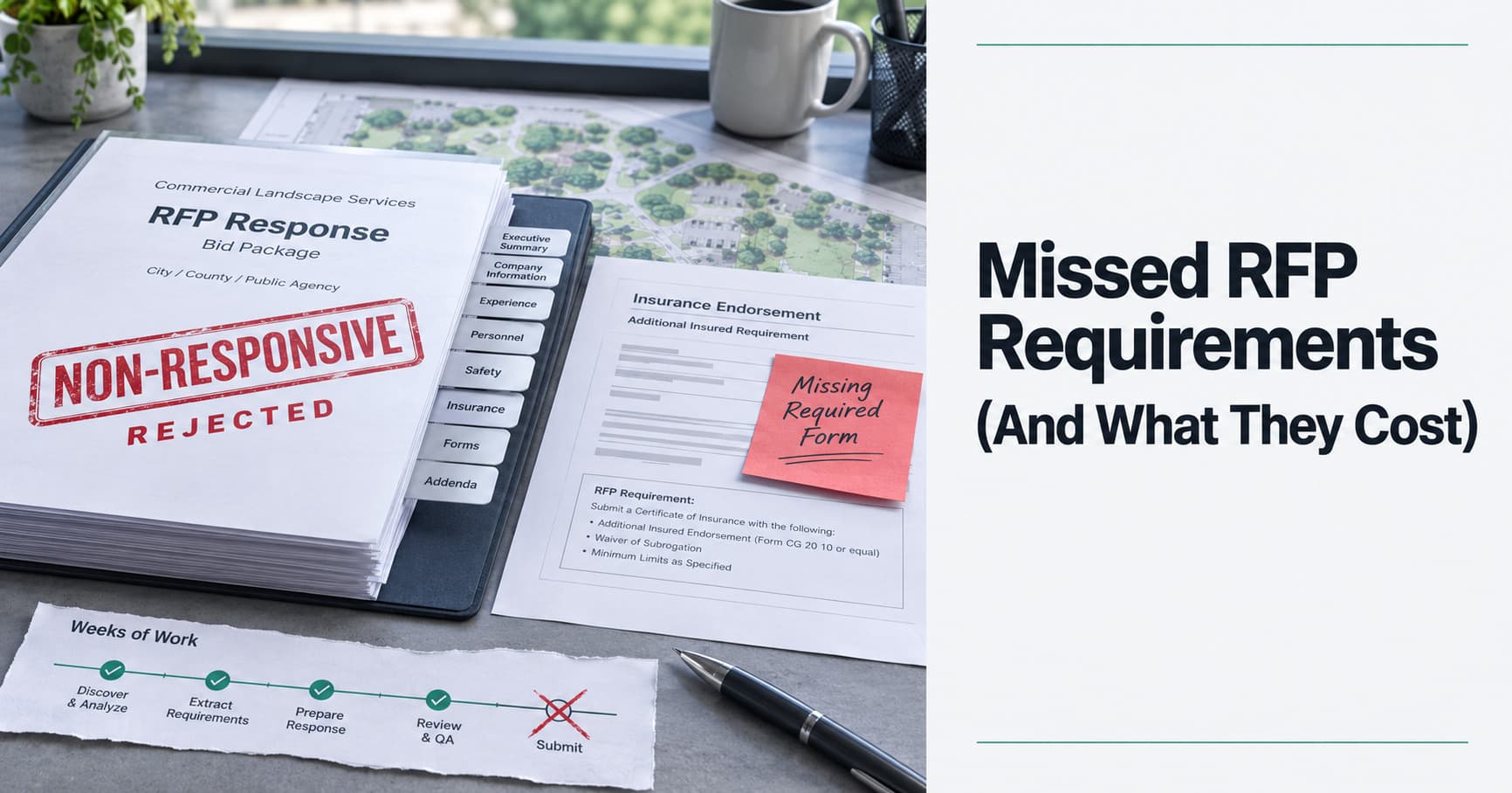
Ask any estimator who's been at this a while and they'll have a version of the same story. Weeks of work on a municipal maintenance bid, site visits done, pricing sharp, references lined up, and the bid gets tossed at the opening. Not because of price. Because of a missing insurance endorsement, an unacknowledged addendum, or a form that was retyped when the RFP said "submit as issued."
Missed RFP requirements are the quietest way to lose in commercial landscaping. Nobody calls to tell you which page you skipped. The bid just doesn't survive the responsiveness check, and all the hours behind it evaporate. This post looks at why manual RFP review misses things so reliably, even with experienced people doing the reading, and what those misses actually cost.
Why Manual RFP Review Fails
It's tempting to blame carelessness. But the estimators missing requirements are usually diligent people working a process that's stacked against them. Here's how.
The requirements aren't where you'd look for them
A commercial landscape RFP is not organized for the reader's convenience. Insurance requirements commonly appear in the instructions to bidders and in the sample contract, sometimes with different details in each. A required certification shows up once, in a sentence inside a scope paragraph. The submission checklist in Section 7 references a form that only exists in Addendum 2.
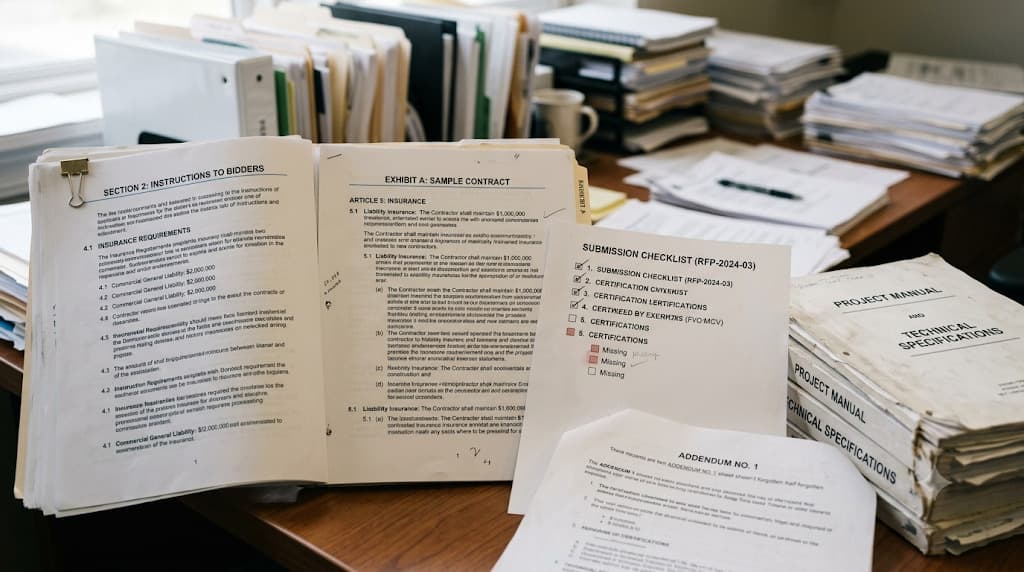
Reading front-to-back doesn't protect you, because the document doesn't put obligations in one place. Every "shall" and "must" is a requirement, wherever it happens to sit, and a 150-page package can scatter dozens of them across sections, exhibits, and attachments.
Volume and deadline pressure collide
Public landscape RFPs routinely run over a hundred pages, and estimators rarely review one at a time. A typical bid shop has several tenders open at once, each with its own deadline, plus change orders and client calls on active contracts. Careful extraction reading takes focused hours that the calendar doesn't offer, so the deep read becomes a skim, and the skim becomes "we've seen this agency's RFPs before, it's probably the same as last time."
It's often not the same as last time. Agencies revise insurance minimums, add certification requirements, and change form versions between contract cycles.
One reader, no net
In most landscaping companies, one person reads the RFP. Whatever that person misses, the company misses, there's no second pass, no cross-check, no structured review. Compare that to how the same company handles field work: nobody sends a crew out without a checklist and a supervisor, but a 150-page legal document gets a single tired read on a Thursday night.
Addenda arrive after the reading is done
The most dangerous requirements are the ones issued after your review. Agencies publish addenda answering bidder questions and revising terms, sometimes days before the deadline. If your process treats RFP review as a one-time event rather than something that stays open until submission, every addendum is a chance to be out of sync with the actual requirements. Failing to acknowledge addenda is one of the most common disqualification triggers in public bidding, and it's purely procedural, it says nothing about your ability to do the work.
Knowledge lives in memory, not in a system
When a requirement is caught, where does it go? In many shops: a highlighter mark, a sticky note, a line in someone's head. There's no single checklist that says "here is every obligation in this RFP, here's where each one came from, and here's its status." So even found requirements get lost between the reading and the submission, the estimator flagged the performance bond in week one, and in the week-three scramble, nobody ordered it.
What a Missed Requirement Actually Costs
The cost of a missed requirement is easy to underestimate because most of it is invisible. Consider a realistic composite: a mid-sized commercial landscaping company bids a three-year municipal grounds maintenance contract and gets disqualified for a missing form. What did that cost?
The estimating labor is gone
A serious response to a multi-site maintenance RFP takes real hours, reading, site visits, measuring, subcontractor coordination, pricing, package assembly, often spread across multiple people over several weeks. All of it is sunk. Unlike a bid you lose on price, you don't even get market feedback for your money; you learn nothing about your competitiveness because your number was never considered.
The contract revenue is gone, for years
Landscape maintenance contracts compound. A multi-year municipal contract isn't just its annual value; it's renewal options, route density that makes neighboring bids more profitable, and incumbency advantage on the rebid. A disqualification doesn't cost you one contract, it costs you the multi-year revenue stream and hands the incumbency to a competitor until the next cycle.
The opportunity cost is real
Those estimating weeks could have gone to a different bid. For a company that can seriously pursue only a handful of tenders a month, spending capacity on a bid that gets tossed on responsiveness is a double loss: the bid you lost and the bid you never made.
Your standing takes a quiet hit
Procurement officers remember non-responsive bidders. It's rarely formal, but a company that submits incomplete packages reads as risky, and on best-value evaluations where judgment plays a role, that reputation is not the tiebreaker you want. Inside the company, it corrodes too: estimators who watch weeks of work die on a technicality don't stay motivated (or employed) forever.
And if the miss survives to award, it's worse
Not every missed requirement kills the bid. Some slip through and get discovered after you win, a prevailing wage obligation that wasn't in the price, a reporting requirement that eats admin hours, liquidated damages you didn't factor. A disqualified bid costs you weeks. An underpriced contract costs you for years, one invoice at a time.
How to Stop Missing Requirements
The fix isn't "read more carefully." Careful reading is what's already failing. The fix is process:
- Extract, don't just read. Every review should produce a structured requirements checklist, every obligation, every required document, every deadline, with the section and page it came from. If it's not on the checklist, your process assumes it doesn't exist. (Our complete guide to reading commercial landscape RFPs walks through this extraction read in detail.)
- Review against categories, not memory. Work from a standard list of requirement categories, insurance, bonding, timeline, personnel, submission forms, eligibility, and the rest, and check the RFP against each one. A category checklist catches the requirement you didn't think to look for.
- Get a second pass on everything. A second reader, or increasingly, AI extraction that scans the full document against those categories and produces a structured list for a human to verify. The point isn't replacing the estimator's judgment, it's making sure no "shall" on page 87 depends on one person's attention span at 9 p.m.
- Keep the review open until submission. Addenda get logged into the same checklist the day they're issued, and the package isn't final until every addendum is acknowledged.
- Trace requirements to the package. Before submitting, every checklist item should map to something in the submission: a certificate, a signed form, a priced line. Untraced requirements are the ones that got found and then lost.
None of this is complicated. It's the same discipline landscaping companies already apply to field operations, pointed at documents.
The Takeaway
Landscaping contractors don't miss RFP requirements because they're careless. They miss them because hundred-page documents, scattered obligations, deadline pressure, and single-reader review make misses statistically inevitable, and because the cost of each miss is hidden until it isn't. The companies that win consistently treat requirement extraction as a system, not a reading assignment.
Want the category checklist? Use our 17-category landscape RFP checklist on your next packet before you price a single line.
When manual extraction is the bottleneck, not the acre: Request a Demo and see how Quoterra structures requirements for human verification on a live RFP.
Optional reading: Full guide to reading commercial landscape RFPs.
Ready to run this on a live RFP?
Quoterra helps commercial landscape estimating desks move from messy RFP packets through Rapid Extraction, AI Site Mapping, Estimator + AI control plane, and Bid Package help for submission, with your team approving the gates.
Request a Demo. Sales-guided beta, US & Canada. Bring your next package if you have one.
Prefer the process map first? See how it works · Explore features
Useful for your next bid cycle?
Talk with Quoterra